

Shelf and stock monitoring
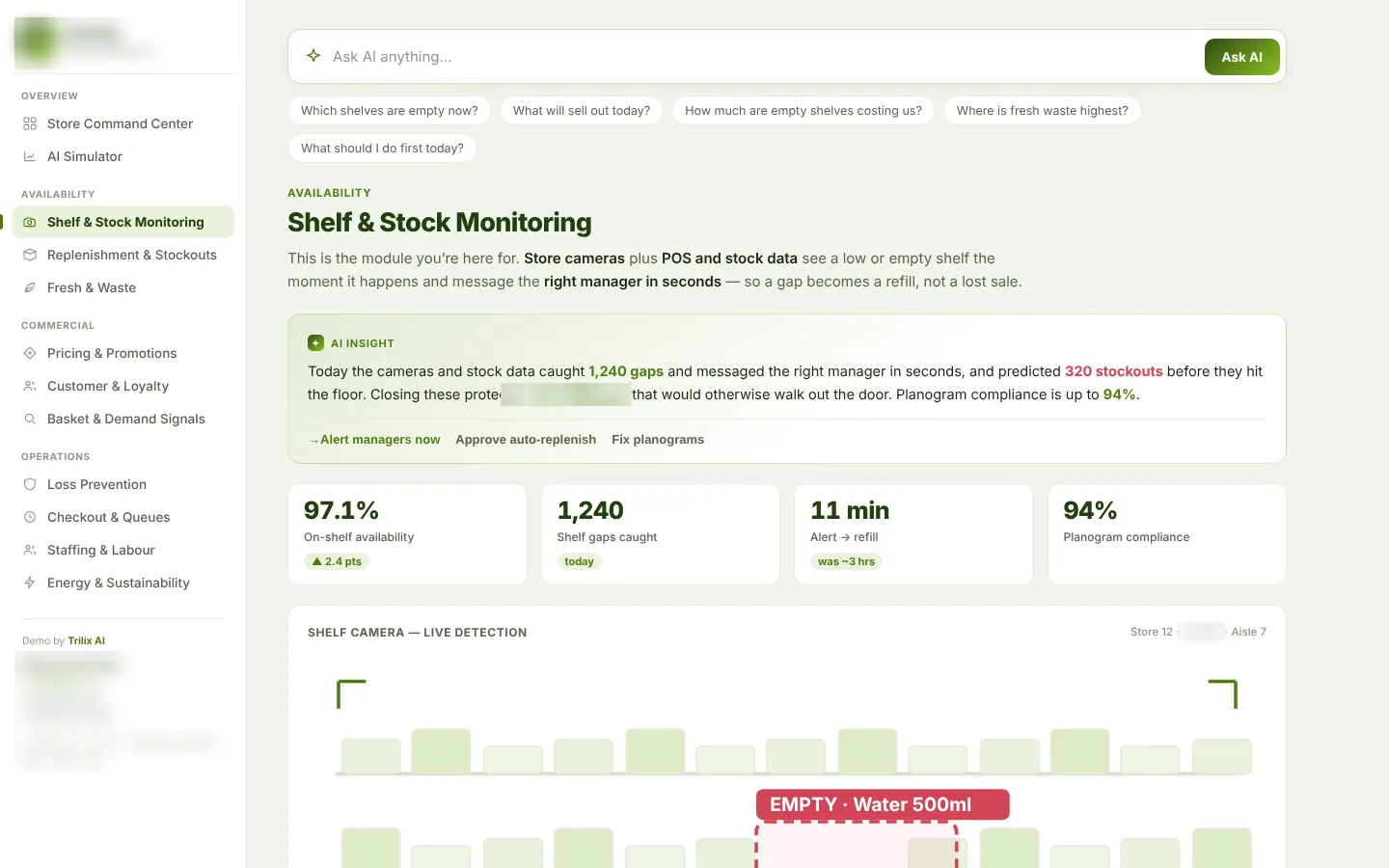
A camera view flags an empty facing and messages the right aisle manager. From there they send a merchandiser, message the manager or mark it done. Low-stock alerts are listed by store and product, with planogram checks.
In-store cameras plus sales and stock data, so a gap on the shelf goes straight to the person who can fill it.
This is a demo build. It runs on sample data. We keep the chain's name private.
At a glance
Demo build, sample data
In grocery, the most expensive thing in the store is an empty shelf. A shopper reaches for water or milk, finds a gap and buys something else, or leaves. In most chains that gap is found on the next walk-around, often hours later.
Fresh has the opposite problem. Order too much and it spoils. Then there are promotions that lose money, shrink at self-checkout, long queues at the busy hour and rotas that don't match foot traffic. A chain with dozens of stores feels all of it every day.
A camera view flags an empty facing and messages the right aisle manager. From there they send a merchandiser, message the manager or mark it done. Low-stock alerts are listed by store and product, with planogram checks.
It predicts what will sell out today from sales pace and stock on hand, then queues reorders or same-day transfers between nearby stores.
Modules around the shelf: fresh and waste, pricing, loyalty, loss prevention, queues, staffing and energy.
How the stores run. The point-of-sale and stock systems, existing cameras, who refills what and how fresh is ordered.
One or two pilot stores. We connect sales and inventory, point shelf detection at a few aisles and set up alert routing.
A first version in about 10 days, then the rollout store by store.
The chain owns its data and the system.
See also AI for retail, franchise and F&B and camera analytics.
Book a call and we'll show you the demo, from a shelf alert to a refill.