

An audit command center
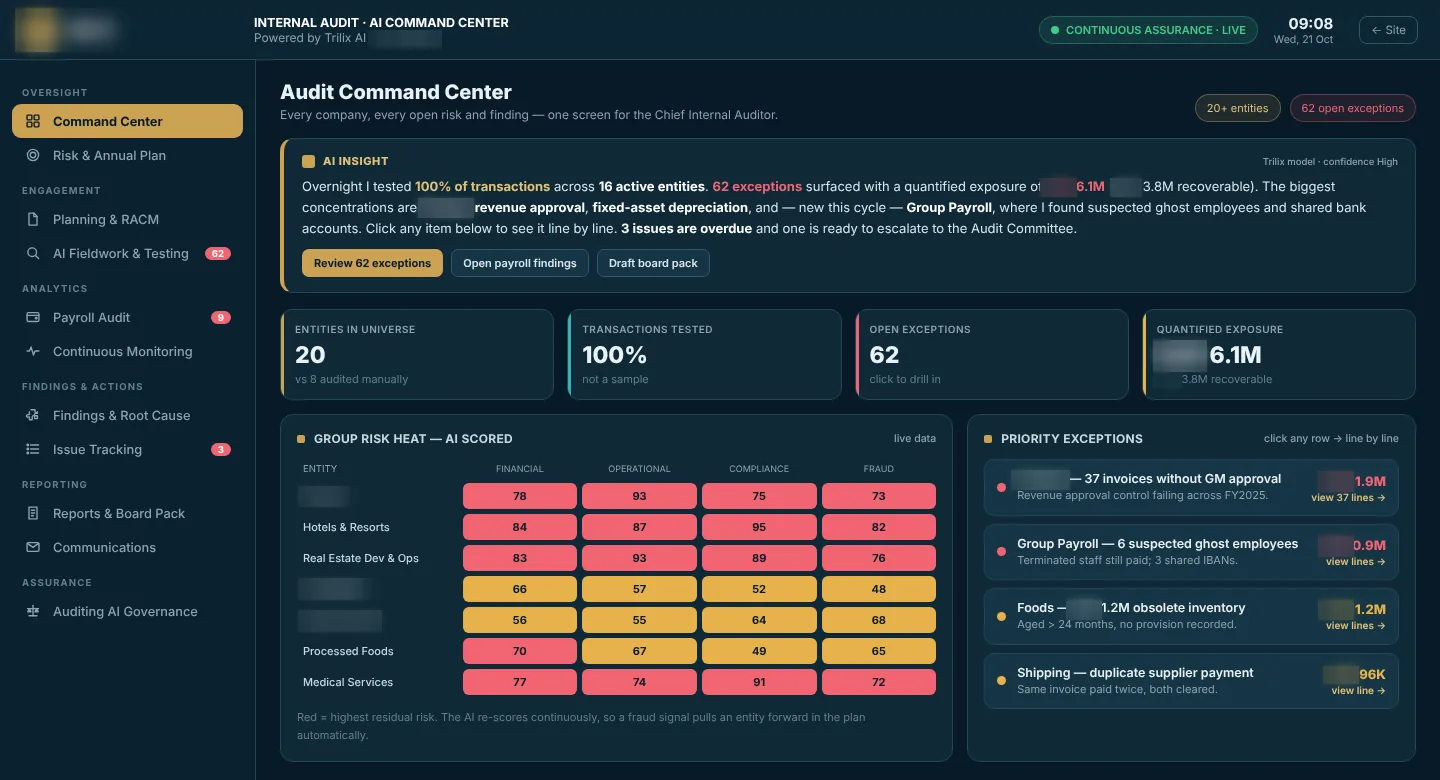
Every entity, open exception and quantified exposure on one screen. A risk heat map scores each company on financial, operational, compliance and fraud risk, and the priority exceptions open line by line.
The whole audit cycle in one place, from risk scoring and planning to testing, findings, follow-up and the audit committee pack.
This is a demo build. It runs on sample data. We keep the group's name private.
At a glance
Demo build, sample data
Internal audit at a large group is stretched thin. There are many companies in very different industries, and a small team that can visit a few of them each year on a fixed rotation. Fieldwork means pulling a sample into working papers. Anything outside the sample goes unchecked.
Group payroll is one of the riskiest areas and one of the least audited. Findings take weeks to write up. Overdue management actions slip. The audit committee gets a slide deck pulled together the week before the meeting.
Every entity, open exception and quantified exposure on one screen. A risk heat map scores each company on financial, operational, compliance and fraud risk, and the priority exceptions open line by line.
The audit steps run over every invoice, asset and stock item. Each exception links to the evidence behind it.
HR records, the payroll register, social insurance records and the bank payment file are cross-checked for ghost employees, shared bank accounts, overtime outliers and payment file mismatches.
The audit function. Its methodology, the group's ERPs, the entities in scope and how findings are reported today.
The data and programs. Ledgers and payroll connected, the team's audit programs loaded and the monitoring rules set.
A first version in about 10 days, usually one entity and payroll.
The group owns its data and the platform. We add tests as the plan grows.
See also AI for financial services and workflow automation.
Book a call and we'll show you the demo, from the heat map to a finished finding.