

Multi-location operators
Several stores, clinics, washes, offices or depots under one owner or group, each running a little differently.
Somewhere between a handful of sites and a big group, the owner stops being able to see everything. One store answers the phone and another doesn't. The weekly report takes a day to build and is out of date when it lands. The back office grows with every location you add.
That's the stage we build for most. Phone agents at every site, one screen for the whole group and automations that do the copying, matching and chasing your managers do by hand today.
Quick answer
Mid-sized, multi-location businesses get the most from three builds: a phone agent at every site with location-level rules, one dashboard for the whole group, and back-office automation that grows with each new location. Roll out at one or two sites first, then the rest. Most first builds go live in about 10 days.
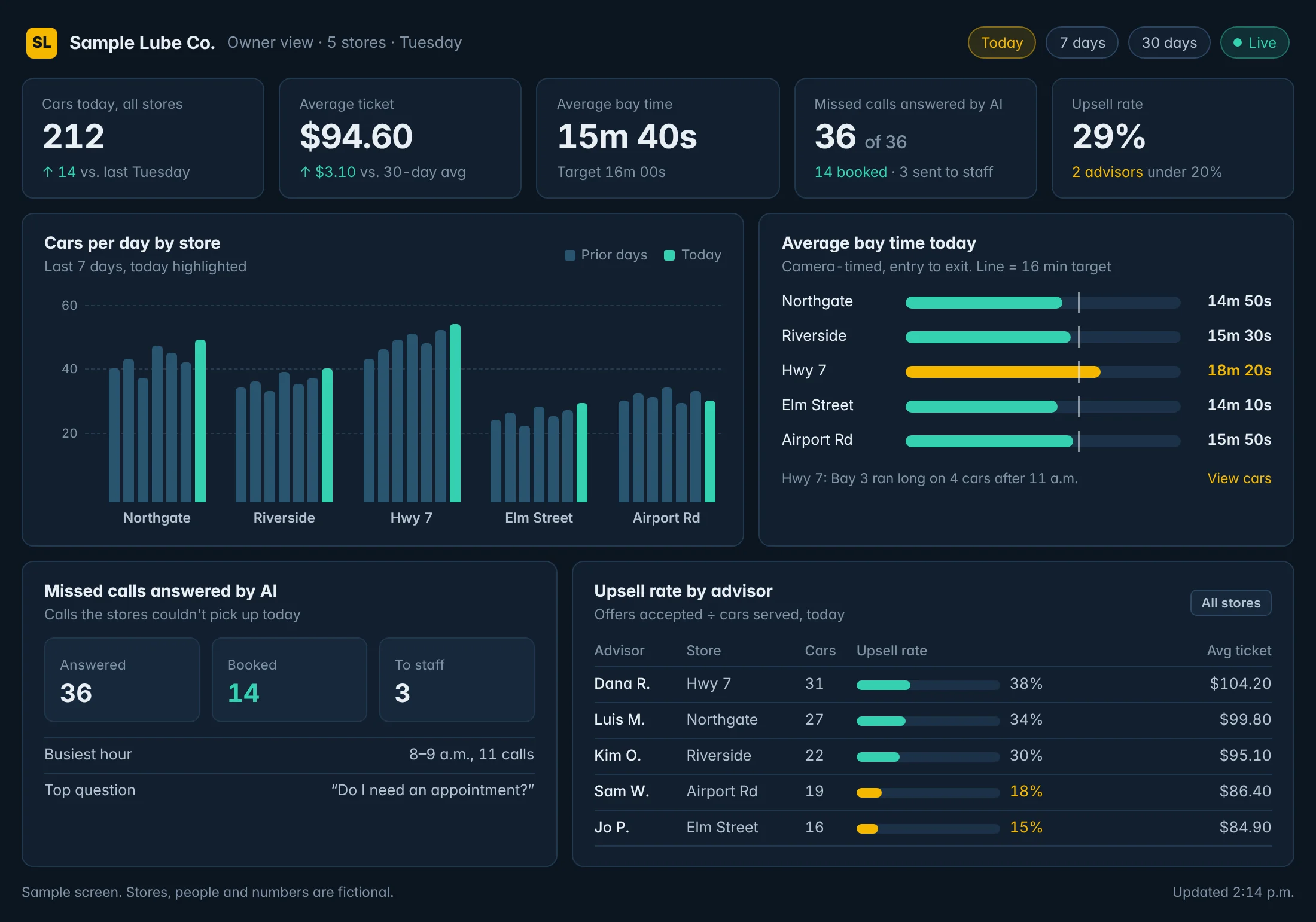
Several stores, clinics, washes, offices or depots under one owner or group, each running a little differently.
You have a POS, a phone system, maybe cameras and an accounting tool. None of them talk to each other, and somebody spends Monday stitching them together.
A small finance and operations team supporting a lot of sites. Every new location adds work for the same few people.
You're acquiring or opening locations and want the next one to run like the best one from day one.
Small businesses need one job off the owner's desk. Mid-sized businesses need the same thing done the same way at every site, and a view of who's doing it.
| What breaks | What we build | What you get |
|---|---|---|
| Phones answered well at some sites, badly at others | An AI phone agent at every location, with each store's own hours and services | Every call answered, and call outcomes by site |
| No single view of the group | An executive dashboard built from your POS, phones and accounting | Yesterday's numbers for every site, every morning |
| Back office grows with every site | Back-office automation: POS to QuickBooks, payroll audits, card reconciliation | The same team handles more locations |
| You can't watch every bay or lane | Camera analytics on the cameras you already have | Counts and times checked against the POS |
| Coaching depends on who's watching | Graded conversations and private recordings for each employee | Managers coach from specifics |
We build and test at one location, on your real phone lines and exports. You judge it on your own numbers before it goes anywhere else.
Rollouts go live in phases, one location or one workflow at a time, so nothing breaks the whole operation at once.
Each site gets its own hours, services, prices and staff. The rules, reporting and logs stay the same across the group.
Owners see the group. A store manager sees their store, not the group's payroll. Employees see their own recordings.
From our case studies. Client names stay private.
Every build is quoted after the first call. The price depends mostly on how many systems we connect, how many locations go live and how many channels are involved.
There's a one-time setup fee per build and a monthly fee after launch. The monthly fee covers hosting, monitoring, fixes and the next items on your roadmap. Adding a location to a system that already runs is far less work than the first build, because the rules and connections already exist.
Want to try it at one site first? The pilot has a fixed setup fee and runs 30 days.
You own the call recordings, camera data, reports and customer records. Hosting is available in Canada, the US or Europe, or in an account your business owns. Actions are logged so anything can be traced back. Read data and security for the details.
If you run one or two locations, AI for small business covers where to start. If you're a large organisation with a procurement process and an IT team, see enterprise AI. For planning across all of it, see AI consulting.
Something else on your mind? Ask us directly or call 416-262-2723.
We don't use a headcount cut-off. If you run several locations or several businesses, have a small head office and the owner can no longer see everything day to day, this page is for you.
No. We build on top of the systems you already run, through their official connections or exports. If one can't be connected, we tell you before quoting.
Most first builds run in about 10 days at the first site. The rest of the group follows in phases, at a pace you set.
Yes. Each site keeps its own hours, services, prices and staff. Group-wide rules and reporting stay consistent.
The system hands off to a person for anything outside the rules you approved. We monitor it after launch, and fixes are covered by the monthly fee.
Mostly auto service and car wash, plus property management, clinics, logistics and holding groups.
On a 30-minute call we'll show you what we've built for multi-location operators and sketch what we'd build first for your group.