

Inbound calls
Answer, qualify, book, quote from approved price ranges, give live wait times, open tickets and transfer to staff with a summary. This is the AI receptionist job, built around your call mix.
Most AI voice agents are sold as a product: sign up, describe your business, forward your number. That works for a lot of businesses. It stops working when the agent has to read from your systems, follow rules that differ by location, or make calls as well as take them.
We build those agents. Trilix AI designs, connects, tests and maintains custom voice agents for businesses in the US, Canada, the UK and Europe.
Quick answer
A custom AI voice agent is a phone agent built for one business: its call flows, its systems and its rules. We map your calls, connect the agent to your scheduler, POS or CRM where they allow it, test it on simulated calls, then audit live calls on a schedule. Most first agents go live in about 10 days.
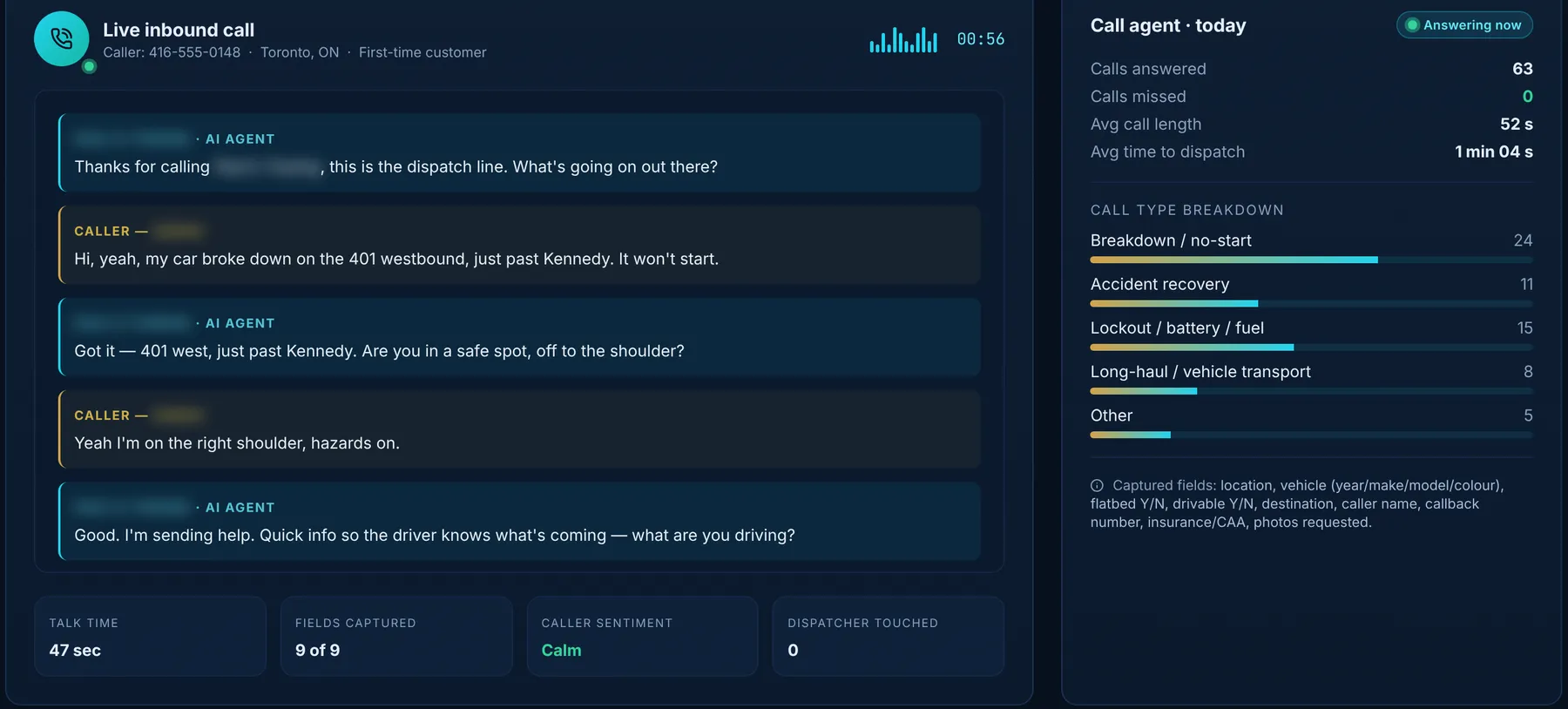
Answer, qualify, book, quote from approved price ranges, give live wait times, open tickets and transfer to staff with a summary. This is the AI receptionist job, built around your call mix.
Call back missed callers, confirm tomorrow's appointments, follow up on an open quote or remind a customer that a service is due. Outbound calling has stricter consent rules, covered below.
A towing call becomes a ticket with the pickup location and vehicle. A maintenance call becomes a work order. A booking lands in the scheduler. The agent fills in the fields so your team doesn't retype them.
An audit agent reviews the voice agent's calls on a schedule and flags the ones that went wrong. Nobody has to listen to every call to know the agent is behaving.
The audit step matters more than people expect. At a multi-store quick lube in Texas, our audit agent reviews the phone agent's calls every 2 hours during shop hours. It showed that the smaller model we started with was ignoring some booking rules, so we moved the agent to a stronger model. Read the Texas quick lube case study.
| Developer voice platform | Self-serve AI receptionist | Custom build with Trilix | |
|---|---|---|---|
| What it is | Tools for engineers to build voice agents | A finished product you configure | An agent designed, built and run for you |
| Who does the work | Your developers | You or your office manager | We do |
| Connects to your systems | Anything your developers build | The integrations the vendor offers | Your systems, through their official connections |
| Rules by location | You build them | Usually one setup per number | Built per location |
| Testing and audits | You build them | Call logs and playback | Simulated calls before launch, scheduled audits after |
| After launch | Your team maintains it | Vendor support | Monthly plan covers monitoring, fixes and changes |
| Best for | Teams with developers to spare | One location, simple calls | Several locations, connected systems, strict rules |
If you have developers and time, a developer platform gives you full control. If you have one location and simple calls, a self-serve receptionist is cheaper. We fit the space between those two.
Outbound AI calls need care. In the US, the FCC ruled in 2024 that AI-generated voices count as "artificial" voices under the Telephone Consumer Protection Act, so robocalls using them need the called person's prior express consent (FCC). We only set up outbound calls to people who have agreed to hear from you, and we keep a record of that consent.
For inbound calls, several US states require consent from everyone on a recorded call, and Canadian privacy law expects notice and consent. Every agent we build opens with a disclosure you approve. Recordings and transcripts belong to you, with access set by role. See data and security.
A custom voice agent is a one-time setup fee plus a monthly fee. Setup covers the call map, spec, integrations, testing and launch. The monthly fee covers hosting, phone and model usage, audits, fixes and small changes. The biggest cost drivers are the number of locations, the number of systems the agent reads from or writes to, and whether it makes outbound calls.
Our AI cost guide explains the pricing models and lists what other vendors publish.
Something else on your mind? Ask us directly or call 416-262-2723.
An AI receptionist is one kind of voice agent: it answers inbound calls at the front desk. "Voice agent" also covers outbound calls, agents that open tickets or work orders, and assistants people talk to by phone. We build both.
Most first agents go live in about 10 days from an agreed spec. Agents that write into several systems or run across many locations go live in phases.
Yes, to people who have agreed to hear from you. Common uses are missed-call callbacks, appointment confirmations and service reminders.
It says so, takes the details and transfers the caller or sends a message to the right person. You decide where that line is.
Yes. The agent works with your existing numbers. We agree the routing with you, including when the agent answers and when calls ring your team first.
You do. We use your recordings and transcripts only to run and improve your system.
Bring your call volume and the calls you'd most like off your team's plate. We'll show you how we'd build the agent.