

Groups and holding companies
Several businesses under one owner, each with its own systems and teams, and leadership that needs one view across them.
Large organisations rarely struggle to find an AI use case. They struggle to get one through security review, connected to the real systems and used by the teams it was built for.
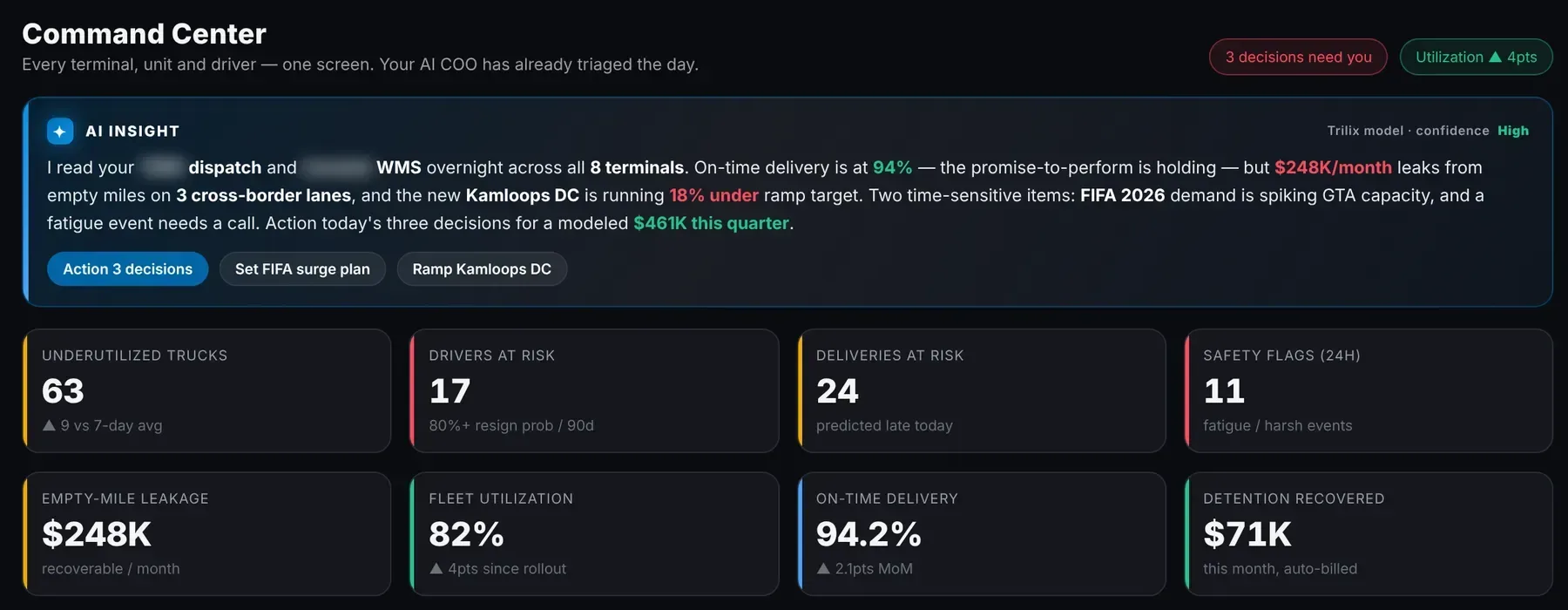
We build custom AI systems for groups, multi-company organisations and larger operators: agents, automations, command centers and knowledge assistants that run on your systems, under rules you approve. This page covers the questions your security, IT and procurement teams will ask, with plain answers.
Quick answer
Enterprise AI from Trilix AI runs on your systems under rules you approve: you own the data, hosting can be in your own cloud account in Canada, the US or Europe, access is set by role, actions are logged and sensitive steps wait for human approval. We build agents, automations, command centers and knowledge assistants.
Several businesses under one owner, each with its own systems and teams, and leadership that needs one view across them.
Networks of stores, clinics, campuses, plants or depots where a change has to work the same way everywhere.
Teams with a specific process to automate, such as month-end, control testing, claims or dispatch, inside an organisation with formal approvals.
You have a mandate to deliver AI and need a build partner that works within your architecture and review process.
Your data belongs to your business. Call recordings, camera data, documents, reports and customer records are used only to run your system.
The system is built for you and around you. Access to your source systems is limited to what the build needs, and where reading is all the system needs to do, the connection is read-only. For a UK holding group, the AI assistant reads Jira and Slack so it knows what each team is working on, and changes nothing in either.
The default. We host and run it, so there's nothing for your team to install or patch.
Hosted in Canada, the US or Europe when your customers, contracts or regulators need the data kept there.
The system runs inside a cloud account your business owns, and you hold the keys.
For stricter environments, parts of the system can run on hardware at your site.
What an agent says, books, changes and refuses is written down and approved by you before launch.
Postings to the books, refunds, messages to customers and anything outside the approved rules can wait for a person, with the context attached.
Calls, bookings, alerts and automated changes are recorded, so any action can be traced back to what triggered it.
Executives, managers and staff see different things. A site manager sees their site, not the group's payroll.
Where it matters, a second AI agent reviews the first one's work and flags problems. At a multi-store quick lube, that audit found the first model ignoring some booking rules, and we moved the agent to a stronger model before it became a customer problem.
Knowledge assistants answer from your approved documents and show where each answer came from. If there's no verified answer, they say so.
We connect to the systems you already run through their official connections or exports: APIs, webhooks, scheduled exports and read-only access where that's enough. Our client systems work with POS data, accounting, phone lines, existing cameras, Jira, Slack and WhatsApp. Our demo builds are designed around ERPs, student information systems, learning platforms and dispatch tools.
We don't ask you to replace a system of record. If something can't be connected, we tell you during scoping and propose the next best route.
| Step | What happens | What you get |
|---|---|---|
| 1. First call | 30 minutes. We show relevant builds and ask how the work runs today | A sketch of a one-year roadmap |
| 2. Discovery | We go through the systems, data, teams and where the hours go | A clear picture of the first build |
| 3. Written scope | What the system does, what it connects to and what it won't do | A spec you approve before any build |
| 4. Security and data review | Hosting choice, access, logging and data handling, with your IT team | Answers in writing for your review file |
| 5. Pilot | One site, one team or one workflow, on a fixed setup fee for 30 days | Results measured on your own data |
| 6. Phased rollout | One location or workflow at a time | No big-bang cutover |
| 7. Run and extend | Monthly fee for monitoring, fixes and the next roadmap items | A system that keeps working after launch |
If your organisation uses a security questionnaire or vendor review, send it early. We'd rather answer it before scoping than after. And if your procurement team requires a specific certification or contract term, ask on the first call. We'll tell you plainly where we stand.
From our case studies. Client names stay private, and demo builds are labelled as demos.
Enterprise builds are quoted after discovery, because the price depends on the systems, sites, users and channels involved. There's a setup fee per build and a monthly fee after launch that covers hosting, monitoring, fixes and new roadmap items. Pilots have a fixed setup fee, so the first commitment is known before it starts.
Something else on your mind? Ask us directly or call 416-262-2723.
You own your data. It's used only to run your system. Hosting can be in Canada, the US or Europe, in an account you own, or partly on your own hardware.
Your data is used only to run your system. Which model providers are used, and under what terms, is part of the written scope and the security review, so your team can check it before anything is built.
Yes. Approval steps are part of the spec. Sensitive actions can wait for a named person, and every action is logged.
We use official connections where they exist and scheduled exports where they don't. We tell you during scoping if something can't be reached, before quoting.
With a pilot: one site, team or workflow, a fixed setup fee and 30 days measured on your own data. Scale happens in phases after that.
Yes. We're based in Vaughan, Ontario, and work with organisations in the US, Canada, the UK and Europe.
Tell us what your IT, legal or procurement team needs to see. We'll walk through where the data goes, who can access it and what we'd build first.