

AI phone and voice agents
Inbound and outbound agents that answer, book, quote from your price ranges and transfer with a summary, set up location by location. See custom AI voice agents.
You've tried the tools. One does calls, another does reviews, a third does reports, and none of them talk to each other or know how your business actually runs. Somebody on your team is the glue, copying numbers from one screen to the next.
Trilix AI is a custom AI development company. We build the system around your process and connect it to the software you already pay for. Then we keep it running.
Quick answer
Custom AI development means building AI software around one business's process and systems instead of adapting the business to a product. We build phone agents, dashboards, CRMs, automations and knowledge assistants to a written spec, connect them to the tools you already use, and keep them running for a monthly fee. You own your data.
Inbound and outbound agents that answer, book, quote from your price ranges and transfer with a summary, set up location by location. See custom AI voice agents.
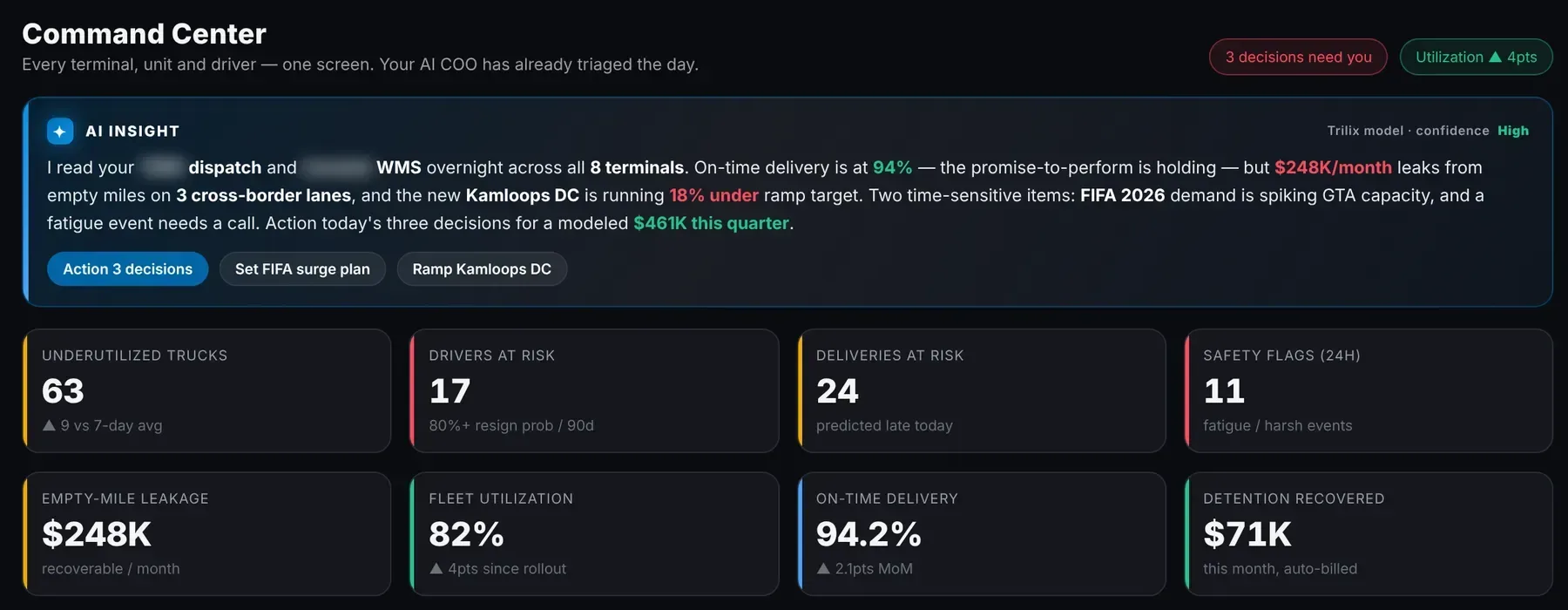
Every location on one screen, from your POS, phones, payroll and cameras, with reports that arrive on schedule. See the executive dashboard.
POS sales into QuickBooks, payroll checks, card reconciliation, review requests and follow-ups. See workflow automation.
Customer records, pipelines, quotes, scheduling and invoicing shaped around how you sell and deliver, instead of a generic CRM you bend to fit.
An assistant that answers staff questions from your own manuals, procedures and past jobs, with the source shown so people can check it.
Car counts, bay time and service checks on cameras you already own. See TrixLink camera analytics.
Buying is often the right call. Here's how we think about it with clients, including when we tell them not to hire us.
| Question | If yes, lean toward buying | If yes, lean toward building |
|---|---|---|
| Does a product already do 90% of what you need? | Buy it and live with the 10% | |
| Is your process standard for your industry? | A vertical product probably fits | |
| Does the work span several systems that don't connect? | A custom build can join them | |
| Do the rules change by location, brand or customer type? | Built-in rules beat workarounds | |
| Are you paying for three tools to do one job? | One system can replace them | |
| Do you need to own the data and where it's hosted? | Check the vendor's terms | You set it in the spec |
If a standard tool fits, we'll say so on the first call. Plenty of problems don't need custom software.
If you'd rather test the idea first, start with a pilot: one location or one workflow, a fixed setup fee and 30 days to judge it.
A lot of good software has no AI in it. Moving a sales total from the POS into QuickBooks is plain logic, and we build it that way because it's cheaper and never guesses.
We use AI where it earns its place: talking to callers, reading documents, summarising conversations, sorting requests, answering staff questions and drafting first versions for a person to approve. Every spec says which parts use AI and why. Anything sensitive, like refunds, postings to the books or messages to customers, can wait for a person's approval.
You own your data: call recordings, camera data, reports and customer records belong to your business, and we use them only to run your system. Depending on what you need, the system can run in your own cloud account, with hosting in Canada, the US or Europe, or partly on your own hardware. Access is set by role and actions are logged. The details are on data and security.
Client names stay private. Each of these is running today:
We also build demos for prospects on sample data, like a stamping plant knowledge assistant and a glass installer job system. They're labelled as demos, and we don't count them as client results.
Every build is a one-time setup fee plus a monthly fee. We quote after the first call, once we know which systems are involved. The main cost drivers are the number of systems we connect, the number of locations, the number of channels and how much of the work needs AI rather than rules.
For the full picture, including what other firms publish, read how much custom AI costs.
Something else on your mind? Ask us directly or call 416-262-2723.
It designs and builds AI software for one business's process, connects it to that business's systems and usually maintains it after launch. The alternative is buying a product and adapting your process to it.
Consulting decides what to build. Development builds it. Some firms do only one. We do both, so the people who write the spec are the people who build it. See AI consulting.
Most first builds go live in about 10 days from an agreed spec. Larger systems go live in phases after that.
No. We start from the systems and exports you have. If something can't be connected, we say so before quoting.
Usually. We connect through each system's official integrations, APIs or scheduled exports. We confirm what's possible on the first call.
We're based in Vaughan, Ontario, and work with businesses in the US, Canada, the UK and Europe. Most of our current client work is in the US.
On a 30-minute call I'll show you what we've built and where I'd start for your business.